
In 2014, ESPN’s David Ching set out to identify the school responsible for producing the most talent at each position in the 2000s. He called his series “Position U.”
Ching covered LSU and the SEC for ESPN and heard LSU’s defensive backs claim the title of Defensive Back U. “I set out to determine whether that was actually the case,” he wrote.1
By his math, it wasn’t. He devised a rubric that awarded points for “winning one of 20 major college football awards, consensus All-Americans, NFL draft picks and coaches’ first-team all-conference selections.”2
Ohio State was DBU with 238 points. Oklahoma was second with 220. LSU was third with 218.3
The Hurricanes were fourth and featured in the top 10 of lots of Ching’s other Position U rankings: Defensive Back U (4th), Linebacker U (T-4th), Offensive Line U (7th), Kicker U (8th). They were in the “rest of” for Wide Receiver U, Running Back U, and Quarterback U.
Most of the Position U rankings were relatively close at the top. Ohio State beat Oklahoma for DBU by just 8.2% and LSU by 9.2%.
The Hurricanes ran away with Tight End U.4 Four points separated the second- and fifth-place program in Ching’s TEU analysis. A difference of 6.5%. Eighteen points separated Miami from the second-place program. A difference of 27.3%.
Only Ohio State’s crown as Linebacker U (222 points) was by a greater margin than Miami’s Tight End U win. The Buckeyes linebackers beat Alabama and Oklahoma (tied with 174 points) by 27.6%.5
That’s the thing about the Hurricanes in the 2000s. Talented? Clearly. More talented than other programs? Yes again.
But it’s more than that. Not merely victory but margin of victory. It’s the metaphorical distance at which Miami tight ends collectively ran ahead of other tight end cohorts.
I enjoyed Ching’s series when he published it in 2014. He’d developed a quantifiable means of settling what’s always been a qualitative debate (my team is better than yours!). But I came to disagree with his central premises, that Position U is best measured at the collegiate level.
I get it. If you’re calling a program the Position University, instinct leads us to look at player performance while at that university. But what’s the purpose of university if not to prepare pupils for professional success? And if that’s the case, what better way to crown Position U than by measuring players’ professional success?
When we look at it that way, the gulf between Miami tight ends and the field widens. In the 2000s, Hurricanes tight ends went to more Pro Bowls, amassed more years as the primary starter for their respective NFL teams, and led all alumni groups in NFL counting statistics like receptions, receiving yards, and receiving touchdowns.
And it’s not close.
Inventing Tight End U
“We’ve had a great tradition here of tight ends, going all the way back to the early 1980s, and we’ve been successful making them a big part of the offense.” - Rob Chudzinski, former Miami tight end, tight ends coach, and offensive coordinator6
Miami’s national title season featured two heralded tight ends.
One would be named the team’s MVP. His backup would finish the following season 16th in the nation in receiving yards. Both would be named All-Americans. Both would be drafted and play in the NFL.
That was 1983.
Glenn Dennison was the Jack Harding Team MVP of the 1983 season and earned second-team All-America honors. He was a second-round pick in the 1984 NFL Draft and played four seasons in the NFL.
Willie Smith, Dennison’s backup in 1983, was a second-team All-American in 1984 and a first-team All-American in 1985. He was selected in the 10th round of the 1986 NFL Draft and played one season in the NFL.
Also on the 1983 roster was Alfredo Roberts, a redshirt freshman who’d spend most of his career as a backup but who’s enjoyed a long NFL coaching career. He’s currently the New York Jets tight ends coach.
Rob Chudzinski came a bit later. He won two national titles with Miami in 1987 and 1989 and graced Sports Illustrated in a two-page spread following Miami’s third national title. He’s also enjoyed a lengthy coaching career, which began at his alma mater.
Miami’s tight ends in the 1980s were solid. Their tight ends a decade later were something else entirely.
In the period of the late 1990s through the 2000s, Miami featured a John Mackey Award winner, three first-team All-American tight ends, including one unanimous All-American, and four first-round draft picks.
And whereas Miami’s tight ends of the 1980s hadn’t blossomed into prominent professional players, Miami’s tight ends of the 21st century certainly did.
It started with Daniel “Bubba” Franks.
Bubba Franks
Miami learned of Franks completely by accident.
Sometime in 1995, Hurricanes recruiting coordinator Pete Garcia traveled to West Texas to recruit a kicker from Midland High School. It was there that the coaches tipped him off about a kid at nearby Big Spring High School.
Franks was “a diamond in the oil patch,” as a local paper put it. Few knew of him outside his home state of Texas, and if you asked Franks at the time, he’d probably tell you even they didn’t truly know him.
Back then, he had to make it clear: “Tight end is my strong position.”
Texas A&M wanted him to play defense. So did Texas. Only TCU recruited him to play tight end, and that was enough to earn the Horned Frogs the inside track to landing Franks. “TCU never told anyone about him,” said Dwight Butler, Franks’ coach at Big Spring. “They thought they were going to sneak away with him.”
Then the Hurricanes got wind. “[Garcia] called me from the Midland airport on his way back home,” explained Butler. “He said he happened to watch film of our scrimmage with Midland High and noticed Daniel. He had me FedEx some game film to Miami.”
“I was surprised that he was not more highly touted,” Garcia said, harkening back to when the Hurricanes honed in on an overlooked Russell Maryland in the 1980s. “We take a lot of pride in finding a couple of those guys every year that fell through the cracks.”7
Hurricanes head coach Butch Davis called Franks not long after hoping to dig up another one of those hidden gems. Davis was compiling his first full recruiting class since taking over at Miami the year before and, grappling with NCAA sanctions limiting him to just 12 scholarships in 1996, faced negligible margin for error.
Every scholarship player had to hit. No big-swing gambles. No guys in academic trouble. No wobbly commitments. “Academics and character are enormously important,” Davis said of navigating the scholarship reductions. “It’s made us be very, very selective. The kids we’re recruiting are going to be impact players. We’re not looking for guys to be depth guys.”8
Davis felt Franks, hidden away in relative obscurity, was one of those high-impact guys. With Garcia in tow, he soon made his way to West Texas, this time to see Franks.
Franks’ wish list was clear. “He wanted to play on grass and he wanted to be sure he could play tight end,” said Butler. He also wanted TV exposure.9
Miami checked all the boxes. The Orange Bowl field was grass. The Hurricanes, despite the sanctions, were a big draw for TV audiences. And, most important, he’d play tight end.
A visit to Coral Gables in January sealed the deal. He verbally committed two days later and signed his letter of intent in February.
Franks redshirted in 1996 and was a freshman All-American in 1997. His 45 receptions for 565 yards and five touchdowns made him a first-team All-American as a junior in 1999.
Prospects for 2000 looked good for the Hurricanes, but Franks had the NFL’s attention. “He’s definitely the Number 1 tight end and a definite first-round pick,” one scout told David Fleming of Sports Illustrated. “You watch him: He’ll just keep rising up the ladder.”10
He left college a year early to enter the 2000 NFL Draft, where the Green Bay Packers selected him with the 14th pick of the first round. He played nine seasons in the NFL, went to three Pro Bowls, and was named the NFL Alumni Association’s Tight End of the Year in 2002.11
Garcia never landed that kicker he’d gone to see in West Texas.12 David Leaverton chose Tennessee and would win a national title with the Volunteers in 1998.
Franks left Miami a couple years shy of the Hurricanes’ fifth national title, leaving behind a legacy that’s resonated for more than two decades. The kid who most programs insisted was a defensive end had invented Tight End U.
Becoming Tight End U
Utilize the tight end to great effect, and other tight ends notice.
Ahead of his junior campaign, Sports Illustrated called Franks one of “10 Players the NFL Wants Now.”13 An Associated Press story that ran midseason in newspapers across the country called him a quarterback’s “dream.”14
Such was the buzz for Franks that had the John Mackey Award for the nation’s best tight end been awarded in 1999, he would’ve been a finalist, if not its winner. (It was first awarded the following season.)
Franks’ success made Miami shine brighter for high school and junior college tight ends looking for a program where they too might shine.
“We’ve tried to make the tight end position lethal,” Chudzinski would say a couple of years later after being promoted to offensive coordinator. “You really have to look to try to do it. It’s not something where you say you want to throw to the tight end. You have to find ways of doing it and making it work.”15
With Franks’ departure began a strange, decade-long pattern whereby the Hurricanes would land elite tight ends through circuitous paths. Paths that ultimately led to Miami because of the program’s success running the tight end.
Losing Franks punched a hole in the Hurricanes depth chart.
“How do you replace Bubba?” Davis said. “It’s been a discussion in our staff meetings a lot. He was the best tight end in America in college football last year.”16
The Hurricanes quickly found their man in Willie Roberts, a local standout who waffled between Miami and Ohio State but committed to the Hurricanes after Franks declared for the NFL Draft, likely eyeing an opportunity to play early.
Roberts was a gem of a tight end. The papers deemed him the state’s top prospect.1718 Columnists anointed him Franks’ successor. And in a recruiting class that featured Willis McGahee, Vince Wilfork, and Jonathan Vilma, it was Roberts whom the Miami Herald dubbed the “Hurricanes’ prize.”19
He was also among a handful of Hurricanes signees struggling to qualify academically, and by late July, hope for a quick rebound from Franks seemed to have evaporated: “SuperPrep All-American tight end Willie Roberts of Miami, the much needed heir apparent to Bubba Franks, will not qualify for UM.”20
Roberts chose the junior college route a couple years later, landing at Northeastern Oklahoma (NEO) A&M. Strangely enough, NEO would supply Franks’ heir apparent. But it wouldn’t be Roberts.
Jeremy Shockey
“I want to go where I can get a good education and also where they utilize the tight end in their offense.” - Jeremy Shockey21
On the last day of July 2000, a phone rang in Ada, Oklahoma. It was Bob Stoops, head coach of the Oklahoma Sooners.
“I heard you’re going to Miami,” Stoops told Jeremy Shockey, a top junior college recruit who’d recently been named a Preseason JUCO All-American. “I want you to come right up here and talk to me. I want to make sure you made the right decision. We have a scholarship open for you.”
“I can’t sign anything,” Shockey told him. “I’m leaving Thursday for Miami.”22
Shockey was a standout at Ada High School in Oklahoma, but few Division I programs had shown interest. Fresno State, Montana State, and Wyoming came knocking, but Shockey had his sights fixed higher. “I knew I was better than that,” he said.23 He enrolled at NEO, confident he’d raise his stock enough to catch the eye of college football’s bluebloods.
That bet paid off. After a tremendous freshman season, scouts and coaches from around the country traveled to NEO’s spring game in May 2000 to see Shockey. Among them: Miami offensive coordinator Larry Coker.
Roberts’ status was already iffy in the spring, so when Coker arrived in Miami, Oklahoma, to check out NEO’s spring game (yes, NEO is in a place called Miami), tight end remained a gap in his offense.
Coker met Shockey after the game and promised an opportunity to play early. “He came to our spring game on May 1,” Shockey said of Coker, “and that night, he told me, ‘We need a tight end. We know you’re good. You’ve already proven it.’”24
Kansas State, Tennessee, and Michigan State also showed interest in the JUCO transfer. But Shockey said he hoped to join a program “where they utilize the tight end in their offense,” and Coker had already proven that with Franks.25
He arrived in Coral Gables less than a month before the opener, took Franks’ #88, and turned in a first year that was remarkably similar to Franks’.
He grabbed 21 receptions to Franks’ 19, for 296 yards to Franks’ 294, and three touchdowns to Franks’ four. His second act was even better, and remarkably similar to Franks’ final season at Miami: 40 receptions to Franks’ 45, 519 yards to Franks’ 465, and seven touchdowns to Franks’ five.
Shockey was a prominent member of Miami’s historic national title-winning roster in 2001 and earned first-team All-American honors after the season. He matched Franks a final time when he left school early to enter the 2002 NFL Draft and also became the 14th selection of the first round, taken by the New York Giants where he’d win his first of two Super Bowls.
Kellen Winslow II
“The deciding factor for Kellen and for me was [Miami wide receivers coach] Curtis Johnson.” - Kellen Winslow Sr.26
Kellen Winslow II’s path to Miami proved as dramatic a recruiting saga as they come. There was a live-on-air signing day announcement that never was. A battle of wills between a famous father and his budding star of a son. And ultimately, consensus for a coach known for forging elite pass-catchers.
“The number five-rated tight end takes viewers behind the scenes to explain how he came to the decision to sign where he did when he makes his intentions clear, live, on the air.”
So promised an ad for a Fox Sports television show that featured Winslow II’s father, the Hall of Fame tight end Kellen Winslow, Sr.27
Winslow II had narrowed his choice to the University of Washington, Michigan State University, and the University of Miami. Now it was time to reveal his decision, live on his father’s show. Or so the ad promised.
The younger Winslow did arrive at the studio the day of his announcement, but it was the second part of the ad’s promise, how he came to the decision, that gave the elder Winslow pause.
In Winslow II’s hand as he arrived was a letter of intent from the University of Washington. He’d had fun on his recruiting trip in Seattle, he told his father, and hit it off with one of the seniors on the team. “You had a fun time when we went to Jamaica, too,” Winslow Sr. said, “but that doesn’t mean you’re going to go there for college.”
“I told him, ‘Kellen, I don’t feel comfortable. If I’m being a bad father by telling you this before you’re supposed to go on national television, so be it. But I don’t feel comfortable.’”28
The announcement never happened. NCAA rules dictated the younger Winslow needed the elder’s signature on his letter of intent, and the elder feared the younger was making a reckless decision. “This was the biggest decision he’ll ever make aside from getting married,” he explained. “He was ready to go, but I wasn’t.”
Everything was on the table as father and son debated where Winslow II would play. Weather (Miami’s nice but “there’s a reason they’re called Hurricanes”), coaches (Washington is starting with a new offense), graduating seniors (Washington was 11-1 last year, but they lost lots of seniors). Even race.2930
Winslow Sr. favored programs with people of color in positions of authority, such as Michigan State, whose head coach, Bobby Williamson, and athletic director, Clarence Underwood, were both black. Winslow II wanted to coach one day, and his father suggested he “play at a place that is going to give you the best opportunity to someday be a coach.”31
“One of the reasons I like Michigan State is I see people who look like me in positions of authority. It’s just one of many things I look at. Does the school look at black people like Kellen and see him as just a jock? Or do they see something more?”32
The younger Winslow countered: What about Curtis Johnson at Miami?
Johnson was Miami’s wide receiver’s coach and had restored the program’s reputation as a pipeline for top-tier pass-catchers akin to the Eddie Browns, Michael Irvins, and Lamar Thomases of the 1980s.
He’d recently developed both Santana Moss and Reggie Wayne, who’d be first-round selections in that year’s draft, and he had Andre Johnson on his way to All-American form.
Coach Johnson personally recruited Winslow II, who played both tight end and wide receiver in high school, and was one of two black assistant coaches on the Miami staff at the time (Andreu Swasey and Randy Shannon soon joined as well).
Winslow II signed with Miami a week after signing day. “The deciding factor for Kellen and for me was Curtis Johnson,” Winslow Sr. said. “I like his style. I like the fact that he is the coach who recruited Kellen and the one who will coach him.”33
Winslow II played as a true freshman behind Shockey in 2001 and emerged as one of Miami’s all-time dynamic playmakers in 2002 after Shockey left for the NFL. He earned second-team All-American honors, was a finalist for the John Mackey Award, and was a force in the national title game, catching 11 passes for 122 yards, and a touchdown in overtime in a losing* effort.34
His junior campaign in 2003 was even better. He was a unanimous All-American, won the John Mackey Award, and left Miami after his junior season to enter the 2004 NFL Draft, where he was the 6th overall selection by the Cleveland Browns.
Greg Olsen
“Notre Dame hopes the Miami Hurricanes’ recent success with tight ends (Jeremy Shockey and Kellen Winslow) won’t lure Olsen south.” - Vaughn McClure, South Bend Tribune35
The path leading Greg Olsen to Miami begins with his brother, Chris Olsen.
Recruiting analysts regarded Chris, an incoming senior at Wayne Hills High School in New Jersey, as one of the nation’s top quarterback prospects in the summer of 2001.
Greg, meanwhile, was entering his junior season at the time but highly regarded in his own right. As recruiters pursued Chris, they simultaneously pursued Greg. Some saw the brothers as a packaged deal, an assumption the Olsens only half-heartedly disputed. “We don’t have to go together,” said Greg. “But I like all the schools he does, so we’d like to go together.”
The Olsens counted Miami among the schools they both liked and visited the campus together several times. Rumors swirled that Chris was “signed, sealed, and delivered” to the Hurricanes after he attended Miami’s summer football camp in June. “I’ve committed to Miami six times already according to the Internet,” Chris said, insisting at the time that he hadn’t yet made up his mind.
A few days later, Chris committed to Notre Dame, assessing that joining the Irish would give him the best opportunity to play early.3637
But he wouldn’t play early. Nor would he play for the Irish at all.
He spent his freshman season on the scout team behind starter Carlyle Holiday and backup Tom Dillingham. And while he remained Notre Dame’s “presumptive quarterback of the future” through the next offseason, Holiday held onto the starting spot despite Chris’ MVP performance in that spring’s Blue-Gold game.38
Chris acknowledged he had a ways to go to pull even with Holiday, but it was clear he wouldn’t be satisfied holding a clipboard for long. “The reason I came here was to be the starter at Notre Dame,” he said after the spring game. “I didn’t come here to be the backup.”39
As Greg’s college decision loomed in the winter of 2003, landing him was a priority for the Irish. It wasn’t just his talent they wanted (Greg was the top tight end prospect in the nation and a top five prospect overall). Getting Greg could instill patience in Chris as he bided his time behind Holiday, suggested South Bend Tribune writer Vaughn McClure.
The Irish just had to hope “the Miami Hurricanes’ recent success with tight ends (Jeremy Shockey and Kellen Winslow) won’t lure Olsen south,” McClure warned.40
Greg chose Notre Dame. But so did a kid named Brady Quinn.
Quinn was a big get for Notre Dame. Recruiting analyst Tom Lemming rated him the nation’s fifth-best quarterback,41 a blue-chipper who by most accounts had quickly learned the Irish offense. “He’s really into his playbook and I think it’s helped him a lot,” said Holiday of Quinn. “I mean, he’s much further along than I ever was as a freshman.”42
Chris remained the presumed backup through preseason camp in 2003. Dillingham missed most of camp with an injured hand. And Quinn, for all his prep and promise, was still a freshman months removed from high school graduation.
But just a couple of weeks ahead of the season opener, Chris transferred to Virginia.
Some speculated he “sensed an impending demotion,” if not in the preseason then in the near future, as he witnessed Quinn’s “advanced assimilation of the Notre Dame offense.”43 Chris later explained that he “left because I felt like I was possibly not the guy they were looking for in the future, and I respect that.”44
Chris’ departure changed things for Greg. “Without a doubt, when my brother left it took something out of being at Notre Dame for me,” he said. “Chris was basically the reason I made the decision to go there in the first place.”45
Greg soon left too, and Miami quickly emerged as the frontrunner to haul in yet another elite tight end prospect. “Greg Olsen did not have a great visit to Notre Dame,” wrote Lemming after the Olsens’ South Bend exodus, “but he did have a great visit to Miami (Fla.). But his dad wanted the family together. And that’s why Greg went to Notre Dame. I think he was pushed into joining the Irish.”46
This time, Greg chose Miami. “If Chris was not in the recruiting picture at all,” Greg said, “I would’ve ended up in Miami in the first place.”47
Greg redshirted in 2003, backed up Kevin Everett in 2004, and emerged as Miami’s next great tight end in 2005 and 2006, earning All-ACC honors as a junior. The Chicago Bears selected him with the 31st pick of the first round in the 2007 NFL Draft. He finished his NFL career ninth all-time in receiving touchdowns by a tight end.
Jimmy Graham
“Randy Shannon sat me down, we had a little conversation, and I made a decision to come back to college.” - Jimmy Graham48
The Miami Hurricanes basketball team used its final scholarship in 2005 to sign Jimmy Graham.
Big-time programs like Duke, North Carolina, and Wake Forest showed interest in Graham, but he’d grown close to Hurricanes head basketball coach Frank Haith, who was among the first to recruit him at tiny Charis Prep in Goldsboro, North Carolina. “[C]oach Haith as a person impressed me,” Graham said. “He built a relationship with me before he even mentioned basketball once.”4950
Miami’s mid-2000s basketball roster was sparse, providing the Hurricanes’ heralded 2005 signees an opportunity to play early. Graham slotted into the Hurricanes’ rotation immediately. He even started several games as a true freshman, though he’d spend most of his basketball career as a sixth man off the bench.
“Jimmy is a big, physical kid, an Adonis who will be a crowd favorite,” Haith said ahead of the 2005 season, a prophetic assessment of his new forward whose tenacity indeed made him a favorite of the Miami student section.51
Graham played physical. Aggressive even. He’d finish his basketball career with more personal fouls (290) than points (202), and Haith even benched him in the middle of his junior season “lest he foul out of every game,” as local sportswriter Michael Cunningham put it.
“He’s crazy, man,” Haith said of Graham in a postgame press conference shortly after removing him from the starting lineup. “No, I’m nice,” Graham objected. “But out on the court I’m just a different person.”52
His senior season ended anti-climatically as Miami fell to Virginia Tech in the ACC Tournament, effectively ending its shot at the NCAA Tournament, and then fell to Florida in the second round of the NIT, definitively ending Graham’s basketball eligibility.
But not his athletics eligibility.
Haith’s decision to play Graham as a true freshman bore fruit four years later and changed Graham’s life. Because he hadn’t used a redshirt year, he was allowed a season of eligibility in another sport. And the football team found itself starved for a tight end for the first time in years.
Dedrick Epps, Chris Zellner, and Richard Gordon shared responsibility for a couple of seasons after Olsen left, but they were a departure from Miami’s elite tight ends of a few years prior. Epps was coming off a knee injury, too, leaving the Hurricanes especially wanting for a reliable tight end.
Maybe that big, athletic forward from the basketball team could help. Tight ends coach Joe Pannunzio had indulged that fantasy as he watched Graham on the hardwood the last couple of years.
After the basketball season, as Haith and Graham began discussing Graham playing overseas, the football coaches discussed Graham.
Word of fan-favorite Graham sticking around Coral Gables another year to play football stirred up a buzz across campus. Even UM President Donna Shalala began asking whether Graham might want to play football, a sport he hadn’t played in nearly a decade.53
“Randy Shannon sat me down, we had a little conversation, and I made a decision to come back to college,” Graham said.54
Things moved fast from there. Less than a month removed from the basketball season, Graham was in meetings with the football team and practicing with quarterback Jacory Harris.55 By July, players reportedly “gushed about him, especially his soft hands.”56
At some point over the summer, Graham’s basketball instincts kicked in as he battled Colin McCarthy for a pass. He threw an elbow to create space from the defender, leaving the linebacker bloodied. “Yeah, he was boxing me out,” McCarthy said.
“I guess I play a little aggressive because that’s the kind of person I am,” Graham said. “And now I can’t foul out. I’m excited.”
Graham was athletic, flashed impressive hands and mobility, and dove head first into football over the summer, but he was still a work in progress. As preseason camp began in August, Shannon expressed tepid optimism at Graham’s ability to contribute.
“Is it a long shot? Yes. But if he can come and give us something this year, if he’s able to go out and score three touchdowns, maybe that’s three we wouldn’t have. You never know. So why not? We’ll see what happens.”57
Graham caught his first collegiate pass in the second game of the season, a 13-yard touchdown reception, but dropped two touchdowns on consecutive plays in the next game. “How men are made is how you come back,” he reflected afterwards. “I’m not going to drop the next one.”58
He kept that promise, hauling in an 18-yard touchdown pass the very next game, the first pass Harris had thrown to him since the drops. The rest is history.
Graham hauled in 17 passes for 213 yards and five touchdowns in his lone collegiate football season. Still a raw prospect despite his obvious potential, Graham fell to the third round of the 2010 NFL Draft where he was selected by the New Orleans Saints. He led the league in touchdown receptions in 2013 and finished his NFL career fourth all-time in touchdown receptions by a tight end.
The pass-catching, touchdown-scoring tight end isn’t quite a modern invention.
Mike Ditka became the position’s first standout in 1961 when, as a rookie, he finished with 12 touchdown receptions, tied for third in the league, a record for touchdowns by a tight end that went unmet for over 20 years and unbroken for over 40.
Tight ends Billy Cannon, Raymond Chester, Dave Casper, and Todd Christensen, who tied Ditka’s record in 1983, each featured prominently in the Raiders’ offenses of the 1960s, 1970s, and 1980s.
And then there was Kellen Winslow, Sr., Ozzie Newsome, Shannon Sharpe, Wesley Walls, Ben Coates, and Tony Gonzalez in the 1980s and 1990s.
But for most of the NFL’s history, most teams used most tight ends as undersized blockers who’d catch the occasional pass.
That began to change at the turn of the century, and Miami’s rise as Tight End U coincided with the position’s 21st century evolution.
“You can look at the tight end position two ways,” said University of Miami tight ends coach Rod Chudzinski in 1997. “The tight end is the worst receiver and worst offensive lineman because he has to do both or, the tight end is one of the most versatile athletes on the field. It’s hard to find guys who are big and strong and physical enough to block, and agile enough to run routes and catch balls.”59
Offenses began adopting more of a pass-first philosophy in the 2000s, and the air raid and spread offenses permeated in the new millennium, first at college programs and later in the NFL. The tight end position flourished in these new offenses as offensive coordinators began recognizing the position as a passing-game advantage to be exploited.
Tight ends accounted for 17.2% of receptions and 19.6% of touchdown receptions between 1960 and 1999. In the 2000s, it jumped to 18.8% of receptions and 22.9% of touchdown receptions. Then to 21.1% of receptions and 25.2% of touchdown receptions in the 2010s.
Look around and it’s hard to find another program that contributed more to this tight end revolution than Miami. In fact, look at it however you like. It’s damn hard to find a way that doesn’t point to Miami as Tight End U.
Tight End U of the 2000s
“[T]he Hurricanes far surpassed the next closest programs at the position.” - David Ching60
How best to crown Tight End U of the 2000s?
Do as Ching and look primarily at collegiate performance? Nah. Bestowing a moniker meant to define a university as adept at producing professional talent requires comparing professional accomplishment.
So we could look at this three ways.
First, tight ends drafted between 2000 and 2009, because one might logically bestow Tight End U of the 2000s based on the tight ends it sent to the league during the decade.
Second, tight ends who played in the 2000s regardless of their draft year, because Tight End U of the 2000s might also suggest tight end performance during that decade.
And third, tight ends who played during The Streak, because that same overperformance we explored in Chapter 2 (not merely victory but margin of victory) rears its head as we compare tight ends across alumni groups.
By tight ends drafted in the 2000s
Of the 153 tight ends selected in the NFL draft between 2000 and 2009, six were Miami Hurricanes: Franks (1st round, 2000), Mondriel Fulcher (7th, 2000), Shockey (1st, 2002), Winslow (1st, 2004), Kevin Everett (3rd, 2005), and Olsen (1st, 2007).
Fifteen tight ends were first-rounders, and Miami alums comprised over a quarter of them (four). No other program produced more than one.
Virginia, Notre Dame, and Iowa matched Miami with six tight ends drafted, but that’s where the comparison ends. The Miami tight ends drafted during the 2000s spent 32 years as primary starters on their respective NFL teams. Iowa’s tight ends managed half that and Notre Dame’s and Virginia’s managed less than half. And the Miami tight ends went to 11 Pro Bowls between them; only the Tennessee alumni group matched them, and that was all Jason Witten.
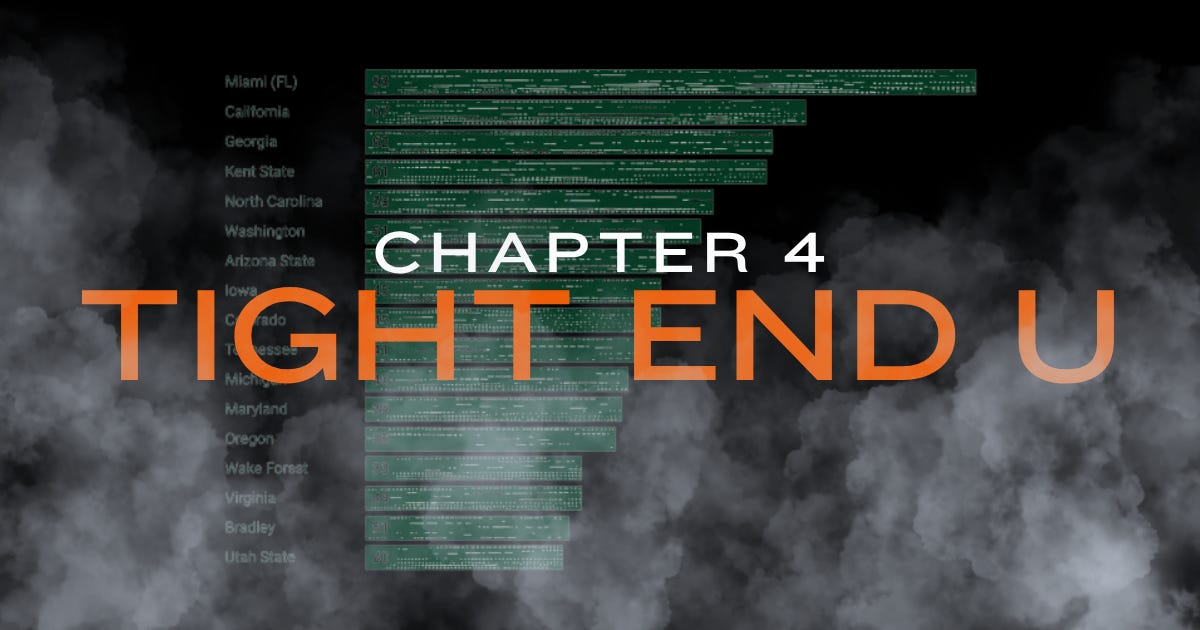
Tennessee is the second most productive alumni group in each of the three counting statistics. And Miami’s miles ahead. Over 600 more receptions, over 7,500 more receiving yards, and 65 more receiving touchdowns.
The difference between Tennessee and the fifth most productive alumni group? Seven-hundred-twenty-seven receptions, 7,551 yards, 27 touchdowns.
Not just victory but margin of victory.
By tight ends who played in the 2000s
Limiting ourselves to only tight ends drafted during the 2000s omits players like Tony Gonzalez, drafted in 1997 but whose career spanned the entirety of the 2000s and who was the decade’s best tight end.
Seven Hurricanes tight end alumni posted receiving statistics in the 2000s: Franks, Fulcher, Shockey, Winslow, Everett, Olsen, and Buck Ortega. Nine USC tight ends recorded statistics, and eight Washington, Virginia, and Penn State tight ends.
The Miami tight ends went to eight Pro Bowls, second behind only California but that was all Gonzalez. The Hurricanes again boat-raced the field in counting statistics.
Georgia followed Miami in receptions, over 300 behind Miami. California placed second to Miami in receiving yards and touchdowns by over 2,500 yards and 26 touchdowns.
The gap between second and fifth? One-hundred-ninety-five receptions, 2,439 receiving yards, and 14 receiving touchdowns.
Not just victory but margin of victory.
By tight ends during The Streak
One-hundred and seventy-four tight ends scored a touchdown or more in the span comprising Miami’s streak. Five of them were Miami Hurricanes – 2.9%. They were Franks, Shockey, Winslow, Olsen, and Graham.
Tight ends caught 1,446 touchdowns during this span. One-hundred-seven were caught by Miami Hurricanes – 7.4%.
Matching the Hurricanes with five tight ends catching at least a touchdown were the Florida Gators, Oregon Ducks, and UCLA Bruins. But only one Bruin (Marcedes Lewis, 17), one Duck (Justin Peelle, 12), and one Gator (Aaron Hernandez, 11) caught double-digit touchdowns.
Forty-eight tight ends caught double-digit touchdowns during this span, including all five of the Miami tight ends – 10.4%. No other alumni group had more than two tight ends produce double-digit NFL touchdowns.
It’s the same story. Georgia followed Miami in receptions and receiving yards, trailing the Hurricanes tight ends by 410 receptions and 4,870 receiving yards. Kent State followed Miami in receiving touchdowns, trailing Miami by 36.
The gap between the second and fifth alumni groups? Two-hundred-sixty-three receptions, 2,023 receiving yards, and 16 touchdowns.
Not just victory but margin of victory.
There’s another interesting pattern that repeats itself from Chapter 2. In that chapter, we dissected the alumni groups’ touchdown totals during the span comprising Miami’s streak and saw prolific quarterbacks like Peyton Manning, Tom Brady, and Drew Brees inflate their respective alumni groups’ totals.
That same pattern is present here.
When we compared tight ends drafted during the 2000s, the Tennessee alumni group was second to Miami in each of the counting stats categories. That was mostly Jason Witten.
When we compared tight ends who played during the 2000s regardless of draft year, California featured prominently. That was mostly Tony Gonzalez.
And when we compared tight end performance during The Streak, the Kent State alumni group entered the mix. That was mostly Antonio Gates.
Miami, meanwhile, saw significant contribution from several tight ends, including Franks, Shockey, Winslow, Olsen, and, in the analysis of tight ends during The Streak, Graham as well.
And without tight ends, The Streak isn’t The Streak.
First, it’s no longer a 149-week streak. Franks saved The Streak in just its seventh week (chronicled in Chapter 3), and later Shockey was the sole Hurricane to score in Week 1 of the 2005 season.
Without the tight ends, The Streak would’ve begun in Week 2 2005 and ended Week 10 2011. A 111-week streak. Still longer than any other program in that era; Purdue alumni are closest with 73 consecutive weeks with an NFL touchdown.
And if you remove the 107 NFL touchdowns scored by Miami tight end alumni during The Streak, you’re left with 561 touchdowns. But that’s still more touchdowns than the alumni group in second, Tennessee with 558 NFL touchdowns.
It’s a stunning testament to the depth of Miami’s talent that we can remove its third-most productive position group and Hurricanes alums still outperform every other alumni group.
Maybe they’re not just Tight End U.
Skill U
One program has two tight end alumni on the NFL’s top 250 touchdown scorers of all time. It’s Miami: Jimmy Graham (89 touchdowns, T-44th all-time) & Greg Olsen (60 touchdowns, T-202nd all-time).
But they’re just two of 12(!) Miami alums in the top 250.
Miami claims more of the NFL’s top 250 all-time touchdown scorers than any other program.
But get this: Nine of the Hurricanes in the top 250 entered the league in 1999 or later. Which means that if you limit Miami to only players drafted in 1999 or later (the last 26 years) but allow all-time players from other colleges (we’re talking 100+ years of history for some programs), Miami still leads all colleges in players on the NFL’s all-time top 250 touchdown scorers list.
Miami is far and away Tight End U of the 2000s, but it makes a serious case for other positions too.
Wide Receiver U
Ching’s Wide Receiver U for the 2000s was USC, despite having just one wide receiver drafted in the first round in the period comprising Ching’s analysis. (Ching didn’t include players drafted in 2000, so he isn’t considering R. Jay Soward, 29th pick of the 2000 draft).61
The Trojans produced a fair share of All-Americans and All-Pac-10 receivers, but as pros, they failed to match the output of other alumni groups. Trojans wide receivers drafted between 2000 and 2009 combined for just one Pro Bowl, six years as a primary starter on their respective professional teams, and they’re nowhere near the top of the receiving stats: 29th in receptions, 31st in receiving yards, and tied for 41st in receiving touchdowns.
There were 334 wide receivers selected in the NFL drafts between 2000 and 2009. Miami was tied for 6th most among college programs with seven: Santana Moss (1st round, 2001), Reggie Wayne (1st, 2001), Andre King (7th, 2001), Daryl Jones (7th, 2002), Andre Johnson (1st, 2003), Roscoe Parrish (2nd, 2005), and Sinorice Moss (2nd, 2006).
Like the tight ends, Miami receivers outperformed the field in their NFL careers, no matter how you look at it.


Running Back U
Ching named Arkansas Running Back U for the 2000s. Miami’s outside the top 10, relegated to those “receiving votes.” He counted six Arkansas running backs drafted in the period comprising his analysis.62
But if we’re defining the 2000s as only 2000 to 2009, not 2000 to 2014 as Ching did, then only three Arkansas Razorbacks running backs were selected in the NFL draft. They combined for zero Pro Bowls, spent five years as the primary starter on their professional teams, and fell flat in the counting statistics too.
Miami had five running backs drafted between 2000 and 2009: James Jackson (3rd round, 2001), Clinton Portis (2nd, 2002), Najeh Davenport (4th, 2002), Willis McGahee (1st, 2003), and Frank Gore (3rd, 2005). That’s tied for second most behind Virginia Tech and Virginia’s six.
Despite just one first-round pick in the decade, Miami running backs outperformed the field in their NFL careers, no matter how you look at it.


I don’t believe Tight End U of the 2000s is in dispute. It’s Miami. The Hurricanes also make a strong case for Wide Receiver U and Running Back U for the 2000s, especially if we’re considering NFL performance.
But now consider all players drafted between 2000 and 2009, regardless of position. Ohio State was first with 69 players drafted. Then Miami with 63.
Those 69 Buckeyes went to 17 Pro Bowls.
The 63 Hurricanes went to 75 Pro Bowls.
Next highest was California with 33. Miami more than doubled them.
And years as a primary starter? Hurricanes drafted in the 2000s were the primary starter on their respective NFL team for a combined 238 seasons. Next? Texas and Ohio State, tied with 168.
Still Tight End U
“It’s absurd that people attempt to make the case for anyone else as tight end U.” - David Hale63
As the 2000s turned into the 2010s, the Hurricanes produced fewer elite tight ends.
Franks retired after the 2008 season, Shockey after the 2011 season, Winslow after the 2013 season, Olsen after the 2020 season, and Graham after the 2023 season.
Clive Walford left Miami after the 2014 season its all-time leader in touchdown receptions by a tight end with 14, breaking Franks’s record of 12. He played five seasons in the NFL.
In 2017, David Njoku became the first Hurricanes tight end in a decade to be selected in the first round. He went to the Pro Bowl in 2023 after catching 81 passes for 882 yards and six touchdowns.
Brevin Jordan and Will Mallory were fifth-round selections in 2021 and 2023, respectively. Elijah Arroyo was a second-round selection in 2025. Njoku, Jordan, Mallory, and Arroyo were all active in the 2025 season, though Jordan spent it on injured reserve.
Hurricanes tight ends drafted since 2010 have been collectively solid, but not the elite bunch drafted in the 2000s. Two-hundred-thirty (230) tight ends have been drafted since 2010. Nine of them were Miami Hurricanes, trailing only Notre Dame with 10. Those nine Miami tight ends are top five in Pro Bowls (6), years as primary starter (18), and receptions, receiving yards, and receiving touchdowns.
But that’s mostly Graham, who was drafted in 2010. Remove him, and Miami’s tight end alumni have been fairly pedestrian: one Pro Bowl, eight seasons as primary starter, 10th in receptions and receiving yards, and ninth in receiving touchdowns. And that’s mostly Njoku.
Miami’s wide receiver alumni of the last 15 years have been similarly pedestrian. Seven receivers drafted, no Pro Bowls, and five seasons as primary starter. They hover in the mid-twenties in NFL receiving stats.
And it’s the same story for Miami’s running backs. Seven running backs drafted, one Pro Bowl, and six seasons as a primary starter. They hover in the teens in NFL rushing stats.
But here’s where things get interesting. Consider the entire millennium thus far (2000 to 2025), and Miami shoots back into the top alumni groups. Even as the talent ebbed and Miami burrowed into its 20-year hibernation of ACC mediocrity, such was the Hurricanes’ turn-of-the-century talent that Miami is still the NFL’s most productive bunch of the millennium.
There were 138 Miami Hurricanes drafted between 2000 and 2025, sixth most among alumni groups. Those 138 players went to a combined 84 Pro Bowls, second after Alabama, and spent a combined 332 seasons as a primary starter on their respective professional teams, fifth among alumni groups.
Now here’s where it gets really interesting.
Hurricanes alumni still rank first in receptions, receiving yards, and receiving touchdowns in the millennium. And they’re second in rush attempts and rushing yards and third in rushing touchdowns.
Still Skill U.
And still Tight End U.
The 15 Hurricanes tight ends drafted in the millennium rank second behind Notre Dame’s 16. But the Miami group went to the most Pro Bowls (17 vs. 11 second place alumni group), spent the most years as primary starter (50 vs. 40 second place), and caught the most passes (3,370 vs. 2657 second place), racked up the most receiving yards (37,667 vs. 30,383 second place), and hauled in the most touchdowns (298 vs. 211 second place).
ESPN revived its Position U series in 2019 and ran it until 2023, this time looking back to the beginning of the BCS era in 1998 through modern times.
In 2019, ESPN wrote: “Miami has so many big names and impact players at the position, it’s hard to deny the program the top spot.”64
In 2020: “No position (aside from kicker) is more clear-cut than tight end, where Miami is hands down the best producer of talent in college football.”65
In 2021: ESPN named the Hurricanes’ Tight End Mount Rushmore: Shockey, Olsen, Franks, and Graham.66
In 2022: “Miami’s position as Tight End U isn’t in doubt for the foreseeable future.”67
In 2023: “It’s absurd that people attempt to make the case for anyone else as tight end U. Miami isn’t just a clear-cut No. 1. The Hurricanes are tops by a country mile (or an Everglades mile, if you will).”68
Miami is still Tight End U. And it’s still not close.
There’s more to this story. Next up: Chapter 5: September 19, 2005
Ching, David. “A Selection of News, Event and Feature Stories: ESPN.com ‘Position U series.’” DavidJChing.com. https://web.archive.org/web/20190423075839/http://www.davidjching.com/stories#:~:text=ESPN.com%20%22Position,for%20the%202000s.
Ching, David. “Position U: Quarterbacks.” ESPN.com, June 17, 2014. https://www.espn.com/blog/ncfnation/post/_/id/95525/position-u-quarterbacks.
Ching, David. “Position U: Defensive Back.” ESPN.com, June 18, 2014. https://www.espn.com/blog/ncfnation/post/_/id/95596/position-u-defensive-back.
Ching, David. “Position U: Tight Ends.” ESPN.com, June 17, 2014. https://www.espn.com/blog/ncfnation/post/_/id/95528/position-u-tight-ends.
Ching, David. “Position U: Linebackers.” ESPN.com, June 18, 2014. https://www.espn.com/blog/big12/post/_/id/85556/position-u-linebackers.
Long, Mark. “Hurricanes Leaning Heavily on Tight End.” Gainesville Sun (Associated Press), November 7, 2002. https://www.gainesville.com/story/news/2002/11/08/hurricanes-leaning-heavily-on-tight-end/31618877007/.
Lee, Mike. “Frankly, Big Spring Recruit Isn’t Worried About Being a No-Name.” San Angelo Standard-Times, February 8, 1996.
Battista, Judy. “Careful, Careful: UM Is After Strong, Select Few.” The Miami Herald, January 21, 1996.
“Pair of Local Athletes Make Verbal Promises.” The Odessa American, January 24, 1996.
Fleming, David. “10 Players the NFL Wants Now.” Sports Illustrated, August 16, 1999.
“Franks Among NFL Alumni’s Best Of 2002.“ Packers.com, December 23, 2002.
Hadorn, Christopher. “MISD Hall of Legends Inductee Leaverton Recalls Storied Kicking Career.” Midland Reporter-Telegram, October 31, 2025. https://www.mrt.com/sports/highschool/article/david-leaverton-recalls-kicking-career-midland-21129189.php.
Fleming, “10 Players.”
Long, Mark. “Hurricanes Tight End Is A Quarterback’s ‘Dream.’” MiamiHurricanes.com (Associated Press), November 10, 1999. https://miamihurricanes.com/news/1999/11/10/205536443-2/.
Long, “Hurricanes Leaning Heavily.”
Degnan, Susan Miller. “Time to Believe.” The Miami Herald, August 25, 2000.
“Dade’s Best.” The Miami Herald, February 1, 2000.
Snyder, Michael. “Hurricanes Cherry Pick From Back Yard.” The Tampa Tribune, February 3, 2000.
Shain, Jeff. “With Sanctions Lifted, Davis Boasts ‘Complete’ Recruiting Class.” The Miami Herald, February 3, 2000.
Degnan, Susan Miller. “Geathers Finally Eligible for UM?” The Miami Herald, July 25, 2000.
Kirk, Otis. “Richardson to Play in California-Texas Shrine Game.” Times Record, June 21, 2000.
Degnan, Susan Miller. “Shockey Picks UM as Sophomore Wants to See World.” The Miami Herald, August 9, 2000.
Milian, Jorge. “Shockey, UM Are a ‘Match Made in Heaven.’” The Palm Beach Post, October 15, 2000.
Degnan, “Shockey Picks UM.”
Kirk, “Richardson to Play.”
Degnan, Susan Miller. “Coker Adds Kellen Winslow Jr. to First Class.” The Miami Herald, February 15, 2001.
Withers, Bud. “Winslow Sr. Won’t Let Winslow Jr. Sign With UW.” The Spokesman-Review (Seattle Times), February 15, 2001.
Drehs, Wayne. “A Racial Divide Between Father and Recruit.” ESPN, March 21, 2001.
Drehs, “A Racial Divide.”
Le Batard, Dan. “Winslow Sr. Guides Son to Hurricanes.” The Miami Herald, February 16, 2001.
Drehs, “A Racial Divide.”
Degnan, “Coker Adds Kellen Winslow Jr..”
Degnan, “Coker Adds Kellen Winslow Jr.”
McClure, Vaughn. “Recruiting in Stretch Run.” The South Bend Tribune, January 8, 2003.
Helfgot, Mike & Kinney, Mike. “Olsen Says Miami Isn’t a Sure Thing.” The Star-Ledger, June 29, 2001.
McClure, Vaughn. “Irish Out-Battle Miami for Strong-Armed QB.” The South Bend Tribune, July 4, 2001.
Kelly, Jason. “Willingham Keeping Same Approach.” The South Bend Tribune, March 28, 2003.
Kelly, Jason. “Olsen Shines in Leading Blue to Win.” The South Bend Tribune, April 27, 2003.
McClure, Vaughn. “Recruiting in Stretch Run.” The South Bend Tribune, January 8, 2003.
Lemming, Tom. “Tom Lemming’s Top 25 Quarterbacks.” ESPN, January 10, 2003. https://www.espn.com/recruiting/s/2003topqbs.html.
Wiltfong, “Former Tailbacks Growin Into New Fullback Role.” The South Bend Tribune, August 17, 2003.
Kelly, Jason. “Olsen’s Happy Feet Open the Door Wider for Quinn.” The South Bend Tribune, August 31, 2003.
Associated Press. “Olsen Brothers Leave Notre Dame; TE Coming to Miami.” Boca Raton News (Associated Press), August 26, 2003.
Harris, Terrance. “As Olsen Brothers’ Time at ND Is History…” The South Bend Tribune, August 26, 2003.
Lemming, Tom. “Quinn, Recruits Will Help ND Survive Olsen Exodus.” The South Bend Tribune, August 31, 2003.
Associated Press. “Olsen Brothers Leave Notre Dame.”
Jackson, Barry. “Forward Graham Will Try Football at UM.” The Miami Herald, April 30, 2009.
Kaufman, Michelle. “Canes Forward Gets Ultimate Assist.” The Miami Herald, November 24, 2005.
Kelly, Omar. “Top Recruit Will Answer Haith’s Call.” South Florida Sun-Sentinel, April 13, 2005.
Kaufman, “Canes Forward.”
Cunningham, Michael. “Graham Gives UM Something to Shout About.” The South Florida Sun-Sentinel, January 13, 2008.
Degnan, Susan Miller. “From Hardwood to Hard Hits.” The Miami Herald, August 13, 2009.
Jackson, “Forward Graham.”
Jackson, Barry. “Florida Sports Buzz: Haslem Inspired by Beasley Debate.” The Miami Herald, April 19, 2009.
Jackson, Barry. “Florida Sports Buzz: Hurricanes Look to Shorten Rotation at Receiver.” The Miami Herald, July 19, 2009.
Associated Press. “Graham Big Man on Campus.” Florida Today (Associated Press), August 12, 2009.
Navarro, Manny. “Graham Feels Sting After Two Drops.” The Miami Herald, September 27, 2009.
Degnan, Susan Miller. “Tight Ends: 3 to Get Ready.” The Miami Herald, August 19, 1997.
Ching, “Position U: Tight Ends.”
Ching, David. “Position U: Wide Receivers.” ESPN, June 17, 2014. https://www.espn.com/blog/ncfnation/post/_/id/95524/position-u-wide-receivers.
Ching, David. “Position U: Running Backs.” ESPN, June 17, 2014. https://www.espn.com/blog/colleges/psu/post/_/id/15941/position-u-running-backs.
Hale, David. “Position U: Why 2023 Could Be a Defining Year for the Rankings.” ESPN.com, August 2, 2023. https://www.espn.com/college-football/story/_/id/38041525/college-football-position-u-2023-usc-gaining-momentum-oklahoma-quarterback.
ESPN.com. “Position U: Which Schools Produce the Most Talent at Each Position.” ESPN.com, June 23, 2019. https://www.espn.com/college-football/story/_/id/27207990/position-u-which-schools-produce-most-talent-position.
Hale, David. “Position U 2.0: Which Schools Produce the Most College Football Talent at Each Position.” ESPN.com, August 25, 2020. https://www.espn.com/college-football/story/_/id/29601197/position-u-20-which-schools-produce-most-college-football-talent-position.
Hale, David. “Position U: Which Schools Produce the Most College Football Talent at Each Position?” ESPN.com, August 2, 2021.https://www.espn.com/college-football/story/_/id/31891050/position-u-which-schools-produce-most-college-football-talent-position.
Hale, David. “College Football’s Position U 2022: Which Schools Produce the Most Talent at Each Position?” ESPN.com, August 8, 2022. https://www.espn.com/college-football/story/_/id/34206607/college-football-position-u-2022-which-schools-produce-most-talent-position
Hale, David. “Position U: Why 2023 could be a defining year for the rankings.” ESPN.com, August 2, 2023. https://www.espn.com/college-football/story/_/id/38041525/college-football-position-u-2023-usc-gaining-momentum-oklahoma-quarterback.


