

A Butterfly, the Irish & the Hurricanes
A notorious “fumble” in 1988 sent Greg Olsen from Notre Dame to Miami in 2003

Every now and then, as I pore over old newspapers, call and clean data, and try to shape it all into something resembling a coherent story for the 149 Weeks series, I stumble upon something interesting and grab onto it. I have to show you this shiny new thing I’d just unearthed, so I stick it into one of the chapters and imagine your eyes widened and eyebrows raised as you encounter it. Fortunately, I (usually) remove those shiny things before publishing. But some are too interesting - or too weird - to shelve forever. So I decided I’d share them under the guise of taking a “Bye Week” from the 149 Weeks series. File this one under ‘things that may interest only me,’ but I hope you enjoy it anyway.
Have you ever heard of the butterfly effect?
Meteorologist Edward Lorenz didn’t quite coin the term but functions as its origin story nonetheless. On a winter morning sometime in the early 1960s, he found himself engrossed in the types of things that engross weather geeks: running atmospheric forecasting models. This particular model simulated weather patterns over a two-month period. It relied on about a dozen variables, like wind speed and temperature. Each variable with its own initial condition (that is to say, starting point), each interacting with the others, and each shaping the outcome.
Lorenz punched some numbers into his computer and walked away to grab a cup of coffee. He’d run this simulation before, so he had an idea of what to expect. But when he returned, he encountered something unexpected: the simulation had produced an outcome dramatically different than it had the first time he ran it. Why?
He pored over the data. It didn’t take long to pinpoint the culprit: .506
As he entered data into the computer, Lorenz relied on a printout that rounded data to the thousandth. The original six-digit .506127 became .506. That small, seemingly insignificant difference altered the simulation’s outcome, and not by just a little bit.123
Scientists had long viewed nature as a series of deterministic events. One thing (or, say, one set of variables) can lead to only one possible outcome. Start at X, end at Y, every single time. So, to accurately predict the weather, for example, you must know every condition of the present (initial conditions) to predict what comes next. But perfect accuracy is impossible.
A slight misreading probably won’t affect short-term predictions. A miniscule misreading of atmospheric pressure today probably won’t affect your forecast for rain tomorrow. But give it enough time or scale, and that imperceptible error (like rounding off a six-digit number to a three-digit one) pushes farther and farther off its expected path.4
Lorenz today is recognized as a founder of chaos theory.5 But it took years for his ideas to spread. He wrote a paper in 1963 explaining the phenomenon he’d observed: “Two states differing by imperceptible amounts may eventually evolve into two considerably different states.”6 He at first explained it by suggesting the air movement caused by the flap of a seagull’s wings could alter the weather forever.
But it wasn’t until he presented the idea in 1972 that his ideas reached a wider audience. That presentation asked a question: “Does the Flap of a Butterfly’s Wings in Brazil Set Off a Tornado in Texas?”
The butterfly effect.
On August 26, 2003, the South Bend Tribune ran a story lamenting the Olsen brothers’ departure from the Notre Dame program.
Chris Olsen was the MVP of that spring’s Blue-Gold game and once viewed as the program’s quarterback of the future. His younger brother, Greg Olsen, was a heralded recruit who’d arrived on campus less than a month ago.
The Tribune ran the article on the front of its sports section, its headline overlaying a nearly full-page photograph of the brothers. “COSTLY TURNOVER?” it read in all caps.7
Ironic. It was a costly turnover in 1988 that kicked off the series of events that’d lead to the brothers’ transfer in 2003.
October 15, 1988. South Bend, Indiana.
There are a few college football games of such notoriety that we know them by a single play.
The Fifth Down. Hail Flutie. “The Band Is On the Field.” Wide Right I. Wide Right II. Wide Right III. Wide Right IV. Wide Left. Games so-named for whatever stunning, outrageous, or bone-headed moment or outcome cemented them in our collective memory.
No game, though, matches the infamy of the 1988 matchup between the Miami Hurricanes and Notre Dame Fighting Irish. Known colloquially as “Catholics vs. Convicts.”
Outlets for public expression were minimal in the 1980s. There was no internet. No social media. No message boards. No chatrooms even.
So if you were a college student or a college football fan in the eighties and you felt a certain kind of way about a rival team, you’d find your options to express your animosity limited. You might hold up a handmade sign. Or do as Notre Dame students did and mail postcards to Miami students.
Or you’d wear a t-shirt.
“You can’t spell scUM without UM,” read one of the t-shirts Notre Dame students printed as they waited for Miami to arrive on campus for the rivals’ 1988 matchup. “Even God Hates Miami,” read another.8
The t-shirts became a thing ahead of the game. The Notre Dame student newspaper warned that such t-shirts were not university-approved.9 Nationally circulated papers like the Washington Post even made reference to the shirts.10
The most famous of the t-shirts, and that which gave the game its name, read “Catholics vs. Convicts.”
“Catholics vs. Convicts” suggests the good guys vs. the bad guys. The good Catholics in the north vs. the criminals down south. “I think the players are a bunch of thugs,” said a Notre Dame student, referring to the Hurricanes. “[T]he epitome of evil,” said another.11
Why the hate?
Some might argue Miami earned the reputation. Just the previous offseason, Miami had dismissed defensive tackle Darius Frazier and defensive back Michael Johnson. Frazier had been charged with drug crimes and Johnson with grand larceny-auto theft.12
There was also the 1987 Fiesta Bowl against Penn State, a game the media wrote up as “The Battle of Good vs. Evil.” Penn State the good. Miami the evil. One columnist even referred to the Hurricanes as walking “with the strut of a street gang.”13 Miami later arrived in Tempe wearing army fatigues.14 (Penn State won the game, and the national title, 14-10.)
Perhaps most of all, the hate was borne from frustration.
Until recently, Miami was just a date on the schedule to the Irish, who won 11 consecutive matchups with the Hurricanes between 1967 and 1980. But ever since, they’d dropped five of the last six, and four consecutive, to their new rivals, usually in spectacular fashion.
1987: Miami 24, Notre Dame 0
1985: Miami 58, Notre Dame 7
1984: Miami 31, Notre Dame 13
1983: Miami 20, Notre Dame 0
1982: Notre Dame 16, Miami 14
1981: Miami 37, Notre Dame 15
Notre Dame’s administration worried about the emotional highs spreading across campus.
It posted notices in dorms warning of consequences for flying banners in poor taste. Head coach Lou Holtz wrote a letter to students in the campus newspaper, The Observer, urging them to show the Hurricanes respect.15 Even the cafeteria stopped selling oranges, fearing students might hurl them onto the field on game day.16
But all of this is beside the point.
It’s not the lead-up to the game we care about for this story. Nor is it the outcome. Not quite, anyway.
What concerns us for this story, is an event that occurred midway through the fourth quarter.
Miami ball at the Notre Dame 11-yard line. The Hurricanes trailing 31-24. “Fourth down and everything,” as play-by-plan man Brent Musburger put it, Miami electing to go for the touchdown instead of the easy field goal.
Quarterback Steve Walsh took the snap from under center, two men in the backfield, including running back Cleveland Gary, who had played the entire game with broken ribs.17 Gary ran a sort-of angle route out of the backfield, crossed behind the linebacker, and spun to grab Walsh’s pass thrown to his back shoulder. He caught the pass at about the two, fell forward, and reached for the goal line.
The ball popped loose. The Irish jumped on it on the three. The officials conferred and rule: Irish ball.
Miami head coach Jimmy Johnson lost it. “First down! First down!” he yelled, gesturing for the referees to make the right call. After the game, squeezing “out the words as they were coated with gall,” as Miami Herald writer Edwin Pope described it, he insisted there was “[n]o question, Gary had the ball at the one. One official told me Gary was down at the one, and I said, ‘Then why isn’t that enough for a first down?’”18
Walsh was just as perplexed. “I went over there screaming, ‘He was down. He was down,’” he said. “One of the officials said to me, ‘Yeah, I know, just relax.’ Then the other came over and overruled him.”19
One of the officials later admitted to blowing the call.
“There was confusion as to whether there was a fumble or not, but there was also a great question about giving Notre Dame the football over on downs. That’s why they got the football. There was no fumble. The ruling was the ball went over on downs. We were wrong in doing it, but the truth is we just had a very bad day.”20
That’s why Johnson was so furious. Miami only needed to get to the four-yard line for a first down. If Gary hadn’t fumbled and the ball was down at the one, it’s a first down for the Hurricanes on the one-yard line.
(The official statement from the Southern Independent College Officials Association, who fielded some of the officials for the game, said its officials stood by the call.21)
For his part, Gary insists he reached the end zone. “I definitely scored a touchdown,” Gary told Sports Illustrated in 2025. “The ground cannot cause a fumble. I scored a touchdown.”22
And for his part, Notre Dame safety George Streeter insists he knocked the ball loose before Gary’s knee touched or the ball crossed the goal line.23
In any case, Miami’s pleas went unheeded. It was Notre Dame’s ball at the one.
The Hurricanes got more last chance with two minutes left in the game.
With Notre Dame deep in its own territory, linebacker Randy Shannon sacked quarterback Tony Rice, who fumbled inside the Irish 15 yard line. Miami recovered, and Walsh found wide receiver Andre Brown in the end zone a few plays later, the clock now under a minute.
Notre Dame 31, Miami 30. An extra-point ties it. A two-point conversion wins it. Johnson went for the win.
Walsh looked for Conley on the right side of the end zone, a lob easily knocked to the ground by defensive back Pat Terrell.
Notre Dame calls it “The Play.” The Irish more or less won the national title on that play.
The impossible had happened, wrote Greg Cote in the Miami Herald the following day. “The game beat the buildup. And somebody beat the University of Miami.”24
It was turnovers that did in the Hurricanes. Seven of them. The “Sinful Seven,” as Cote called them.
1st Quarter: Steve Walsh fumbled at the UM 41
1st Quarter: Walsh intercepted at the UM 31
2nd Quarter: Walsh intercepted at the ND 40
3rd Quarter: Leonard Conley fumbled at the UM 37
3rd Quarter: Walsh intercepted at the ND 23
4th Quarter: Cleveland Gary fumbled* at the ND 1
4th Quarter: Walsh fumbled at the ND 28
Point to any of the seven, and you’d be right to decry a missed opportunity in such a tight game. Somehow, only two turned into scores: a 60-yard pick-six by Terrell in the second quarter and a field goal in the third.
But it’s the Gary fumble that lives on in infamy. It’s the Gary fumble-that-wasn’t-a-fumble that leaves us wondering, what if? What if the officials had gotten it right? What if they’d placed the ball on the one yard line and called a first-down for Miami?
What if Miami then scored? Would they’ve won the game? Would Miami, not Notre Dame, had played West Virginia for the national title?
The game’s short-term consequences were easy enough to predict.
Notre Dame would rise in the AP Top 20 rankings. And Miami would drop. Notre Dame had become more likely to play for the national title game. And Miami less so.
And that’s exactly what happened. Notre Dame climbed from #4 to #2 after the game. Miami fell from #1 to #4. And Notre Dame would play for, and win, the national title.
Less clear were the fumble’s long-term ripples. What imperceptible conditions were present at the time that’d have far-off consequences?
Here’s one. A nine-year-old boy at home in Tennessee would watch Notre Dame, not Miami, take on his beloved University of West Virginia Mountaineers in that season’s national title game.
He’d watch Notre Dame, not Miami, beat West Virginia to become national champions of the 1988 season. He’d cry afterwards. But he’d be so taken with Notre Dame and their golden helmets that he’d enroll at the university a decade later. We couldn’t have known in 1988 that his admiration for Notre Dame would spread to his family, and to friends of his family.
Had the refs gotten the call right in 1988, Greg Olsen may never have become a Miami Hurricane in 2003.
January 2, 1989. Columbia, Tennessee.
Growing up in Columbia, Tennessee, nine-year-old Kelechi Ndukwe might’ve seen the Associated Press story that ran in The Tennessean the day after Notre Dame’s victory.
“A Classic Irish Fable,” read its headline. It only slopped more unabashed praise on top of it. “It was the Gipper and the Four Horsemen; it was Rockne, Lea and Parseghian. It was another chapter in the history of college football’s most storied school.”25
But Kelechi had little time for Notre Dame in the fall of 1988. He was a Mountaineer.
When Kelechi’s father, Stephen, immigrated to the United States from Nigeria years earlier, he’d contacted universities around the United States inquiring about their curriculums. He chose WVU for its affordable tuition. His mother, Nnenna, also attended.
The University of West Virginia was dear to the Ndukwes. Yes, Stephen had stayed in an apartment so cramped he claimed not to be able to fully stand up inside of it. And he’d endured harassment as a recent immigrant, like when some of the fraternity brothers on campus would regularly soak him with beer.
But Stephen and Nnenna held WVU in high esteem nonetheless. The school had given the Ndukwes a good education and their family a future. Stephen earned Bachelors and Masters degrees in mechanical engineering and later found work as an engineer for General Motors and then for Saturn, the Tennessee-based automaker.26
It was there, from his family’s home in Tennessee, that Kelechi witnessed West Virginia’s remarkable 1988 season unfold.
The last time West Virginia defeated both of its primary rivals, Pittsburgh and Penn State, in the same season, Dwight Eisenhower was less than a year into his presidency. That was 1953.
The Mountaineers would finish the occasional season in the AP Top 20. And they’d go a bowl game now and then. But WVU was far from college football’s glitterati.
That changed when Don Nehlen took over in 1980.
Nehlen was the former head coach at Bowling Green and spent the last few seasons as an assistant at Michigan. Whereas West Virginia finished in the AP Top 20 just five times prior to 1980, they finished in the top 20 three consecutive seasons between 1981 and 1983. And whereas bowl games were historically an occasional treat, Nehlen brought them to four straight from 1981 to 1984.
The middle of the decade brought some down years, but 1988 looked promising. Sixteen of 22 starters were back, standout quarterback Major Harris among them. “On paper, we have a decent club,” Nehlen said, “but we have a long way to go before we are as good as some people think we’re going to be.” Lenn Robbins, writing for The Record, compared Nehlen’s soft assessment to “a man who knows he has a good hand and doesn’t want to tip it.”27
On September 24, 1988, WVU beat Pittsburgh 31-10. And on October 29, they beat Penn State 51-30. Nehlen’s Mountaineers finished the 1988 regular season with a 31-9 win over 14th ranked Syracuse on November 19, ending the year undefeated. Notre Dame, meanwhile, delivered USC its first loss of the season and knocked the Trojans from title contention.
The Fiesta Bowl would feature the nation’s two remaining undefeated teams. West Virginia would take on Notre Dame for the national title.
But there’s not much to say about the 1989 Fiesta Bowl. Harris, the West Virginia quarterback, separated his shoulder on the third play of the game. He continued, but was clearly hampered. “My timing just wasn’t right,” he said later. “I was just hurting.” Nehlen admitted to avoiding the option play, the bread and butter of the WVU offense, out of fear Harris would further injure his shoulder.28
Notre Dame jumped out to a 23-6 lead at halftime, and while Harris brought the Mountaineers to within a couple scores in the third quarter, the game was never really close.
The Irish won 34-21.
The loss brought nine-year-old Kelechi Ndukwe to tears.
Soon, those tears turned to curiosity. Then admiration. The game stayed with Kelechi for a long time. But it wasn’t the loss he was stewing over. It was those golden helmets.
“It kind of planted a seed,” Kelechi said of the game. He started telling his parents he wanted to attend Notre Dame, and they too would grow enamored with the “classic Irish fable.”
“The first time we set foot on campus, we all felt it,” Kelechi’s father, Stephen, said. “For Nnenna, for some reason, she said it felt like this is where God was. She said this is where dreams are made. I said to myself, ‘This is awesome,’ and everything came together.”29
Kelechi studied chemical engineering at Notre Dame on an ROTC scholarship (he was later commanding officer of the USS Halsey30). He’d often invite his youngest brother, Chinedum, then in middle school, to visit, and Chinedum would usually bring his best friend along to check out the campus.
That friend was Brady Quinn.
August 12, 2002. Columbus, Ohio.
When he was in seventh grade, Chinedum begged his parents to let him play football.
Stephen and Nnenna had recently moved the family to Columbus, Ohio, and Chinedum had become friends with a kid in town named Brady. They first met playing baseball, but Brady soon encouraged his new friend to try football. The Ndukwes were skeptical but eventually relented.
The families grew close, and Chinedum and Brady became like brothers. They played football, Quinn the quarterback and Ndukwe the wide receiver, shared classes, and went to the movies.31
And they visited Notre Dame. Kelechi often invited the family, Quinn included, to South Bend, hoping they’d “see what makes Notre Dame what it is.”
“I’ll never forget an incident one time,” Stephen recalled, “when Chinedum and Brady and the other boys came back to the dorm room after the game and they thought I was asleep. It was nice to listen to them marking out their strategy. They were going to go to the party and they were going to tell the girls at the party they were (high school) seniors being recruited.”32
“Yeah we told some of the girls that we were football recruits who were thinking about going to Notre Dame,” Quinn would say later, though it was unclear if he was referring to the same occasion that Stephen recalled.
“I was the one who started talking to the girls,” Ndukwe countered, teasing his long-time friend. “Maybe Brady got their attention, because he has the looks, but I did all the talking.”33
Quinn threw for 2,200 yards and 21 touchdowns as a junior at Dublin Coffman High School. Ndukwe caught 59 passes for 840 yards and 12 touchdowns. The media began calling them “the Dublin Duo,” and they spoke openly of playing college football together.34
Scouts soon put Chinedum and Brady on their radars. Programs around the country called, sent letters, and even showed up on their high school campus. But Notre Dame was quiet. Not a peep. And it stung. He asked Brady if he’d heard anything, but he reported the same: nothing from the Irish. “Maybe Notre Dame is stupid,” Chinedum wondered.35
Brady suggested they attend Notre Dame’s summer football camp that June ahead of their senior season. Chinedum’s father, Stephen, agreed. “If they’re not opening their eyes, go open their eyes up for them,” he told his son. So he did.
Notre Dame offered Chinedum a scholarship on the spot.36
But Brady received no such offers. At least not from Notre Dame.
Louisville was first to offer him a scholarship. Ohio State did too. And Michigan. As the summer wore on, Brady seemed to lean toward the Wolverines.
Brady Quinn could’ve very well been a Michigan Wolverine had Chinedum’s father, Stephen, not spoken with Notre Dame coach Ty Willingham. “He told Ty that Brady was better than anybody he had on his team right now,” said Mark Crabtree, Brady and Chinedum’s high school football coach.37
Willingham offered Quinn a scholarship that July. He accepted in early August.38
August 24, 2003. South Bend, Indiana.
Chris Olsen’s phone was still ringing two months after his verbal commitment.
“They were just calling to say, ‘Hi,’” he said, probably a little wryly. “I don’t think they were really trying to push me to decommit from Notre Dame.”
Olsen verbally committed to Notre Dame head coach Bob Davie over Fourth of July weekend in 2001. The early commitment freed him to focus on his upcoming senior season, he said. And besides, he was very comfortable with his decision. His dad, Chris Olsen Sr., the head football coach at Wayne Hills High School in New Jersey where Chris played, made sure of it.
“My dad said no matter what, I’m sticking with this, and that’s fine with me. When I get these phone calls, I’m just going to say, ‘Thanks for calling.’”39
No matter what turned out to be relentless in the fall of 2001.
First, Chris tore his ACL in the first game of his senior season but returned to the field wearing a knee brace a few weeks later, postponing surgery until December.40
Then, Notre Dame fired Davie after the Irish finished 5-6 and missed out on a bowl game for the second time in three years.
And then, the man they’d hired to replace Davie, George O’Leary, resigned after just five days on the job when it was revealed he’d lied on his resume years before.41 Chris learned the news as he was coming out of ACL surgery.42
When Tyrone Willingham was named coach soon after, Olsen admitted he was concerned, having never been recruited by Willingham when he was the head coach at Stanford.
But Willingham’s pro-style offense was more Chris’s speed than Davie’s, which made liberal use of the option. “Coach Willingham told me he runs a pro-style offense, and that I’m the type of quarterback he likes to play with,” Olsen said. “He told me he wasn’t recruiting any other [passing] quarterback.”43
Chris kept his commitment and spent his freshman season as a scout-team tackling dummy44 behind starter Carlyle Holiday and backup Tom Dillingham.
Chris’s little brother, Greg, meanwhile, was a top tight end prospect in the summer of 2001. “He’s big-time,” Chris said of his brother, then entering his junior season. “Maybe he’ll follow me to Notre Dame.”45
He did. Greg signed a letter of intent for Notre Dame in February 2003. And so did an eager Brady Quinn.
Chris had been the spring game MVP and hoped to challenge Holiday for playing time in 2003. “The reason I came here was to be the starter at Notre Dame,” Chris said after the game. “I didn’t come here to be the backup.” He acknowledged a long road to catch up to Holiday, but it was clear Chris wouldn’t be content holding a clipboard for four years.
Both young quarterbacks, each of them blue-chip prospects, had a real shot at competing for the backup spot behind Holiday, who’d solidified the starting job in spring practice. It’d depend on what they did over the summer, their offensive coordinator said, and how they look in preseason camp.46
Quinn is said to have begun studying his playbook the day his new coaches sent it to him, all 465 pages of it. He “digested it regularly,” his high school coach said.47 Even his competition noticed. “He’s really in his playbook and I think it’s helped him out a lot,” Holiday said of Quinn. “I mean, he’s much further along than I ever was as a freshman.”48
A year earlier, Chris too immediately dove into his playbook after signing his letter of intent. He began “metabolizing” it during study hall as a high school season, as Eric Hansen of the South Bend Tribune put it.49
Chris remained the frontrunner for the backup job as preseason camp got underway. Dillingham, the previous year’s backup, missed most of camp with an injured hand. And Quinn, for all his prep and promise, was still a freshman months removed from high school graduation.
But as preseason camp wound down, and just a couple of weeks ahead of the season opener, Chris decided to leave Notre Dame.50 It’d become clear to him, he said, that the coaches didn’t view him as the future at the position, and he respected that.51
He transferred to Virginia. NCAA rules required he sit out a year after transferring, so he bided his time behind Matt Schaub and then Marques Hagans before entering his redshirt senior season as the starter and team captain.52 But he’d relinquish the starting job just a few games into the season. He accepted the demotion with grace, tutored freshman quarterback Jameel Sewell who had assumed the starting role, and remained a team leader.53
Four games into Notre Dame’s 2003 season, Quinn took over for a struggling Holiday and held the starting spot for four years.
August 27, 2003. Miami, Florida.
Attention quickly turned to Greg’s future. Would he follow his older brother’s lead and leave South Bend? Were the Olsen brothers a packaged deal?
“I told Greg that he was separate from Chris,” Chris Sr. said. “He can’t let Chris’ situation bother him. He has to be his own guy.”54
The next day, Greg left Notre Dame too. “I’ve said this from the beginning,” wrote recruiting analyst Tom Lemming shortly after the Olsens left Notre Dame. “Greg Olsen did not have a great visit to Notre Dame but he did have a great visit to Miami (Fla.). But his dad wanted the family together. And that’s why Greg went to Notre Dame. I think he was pushed into joining the Irish.”55
Call it what you will - a desire to play with his brother, a push from his father - Chris’ departure changed things for Greg. “Without a doubt, when my brother left it took something out of being at Notre Dame for me,” he said. “Chris was basically the reason I made the decision to go there in the first place.”56
This time, he didn’t follow his brother. On August 27, the Miami Herald reported that Greg applied for admission to Miami.57 He redshirted in 2003, backed up Kevin Everett in 2004, and emerged as the next great Miami tight end in 2005 and 2006, earning All-ACC honors as a junior. He was selected with the 31st pick of the first round in the 2007 NFL Draft by the Chicago Bears.
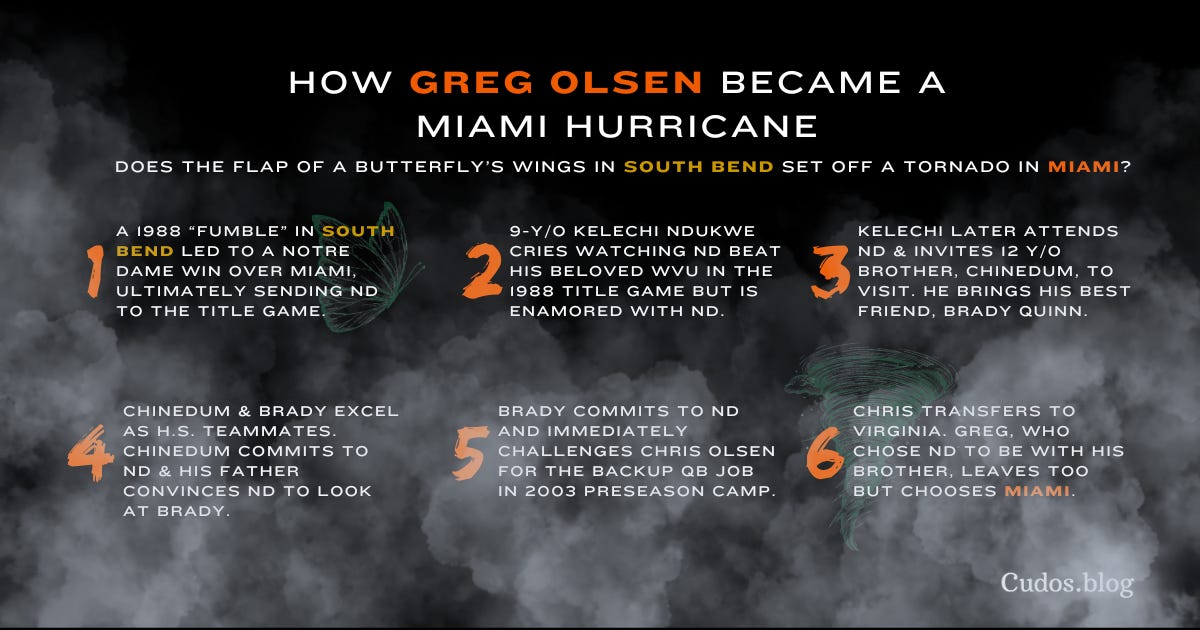
And that’s how those initial conditions from South Bend, Indiana, in 1988 - a blown call that turned the Irish into a frontrunner to play for the national title - set in motion a series of unpredictable events, owing to a number of imperceptible variables.
A surprise national title run by West Virginia.
A young Kelechi Ndukwe rooting for WVU to take down Notre Dame for the national title but growing enamored with the Irish.
The Ndukwes’ move to Columbus, Ohio, where younger brother Chinedum would befriend a kid named Brady Quinn.
Chinedum and Quinn’s growth into high school football stars.
The elder Ndukwe encouraging the Notre Dame coaches to take a closer look at Quinn.
Quinn battling Chris Olsen for the backup quarterback spot, and the future at the position in South Bend.
Chris transferring to Virginia in search of an opportunity for playing time.
Chris’ brother, Greg, who chose Notre Dame to be with Chris, leaving too.
And Greg choosing this time not to follow his brother, choosing instead to attend the University of Miami.
The butterfly effect.
Siegfried, Tom. “Born Half a Century Ago, Chaos Theory Languished for Years.” ScienceNews, September 16, 2013. https://www.sciencenews.org/article/born-half-century-ago-chaos-theory-languished-years.
Dizikes, Peter. “When the Butterfly Effect Took Flight.” MIT Technology Review, February 22, 2011. https://www.technologyreview.com/2011/02/22/196987/when-the-butterfly-effect-took-flight/.
APS. “This Month in Physics History: Circa January 1961: Lorenz and the Butterfly Effect.” American Physical Society. https://www.aps.org/archives/publications/apsnews/200301/history.cfm.
Siegfried, “Born Half a Century Ago.”
APS, “Circa January 1961.”
Lorenz, Edward N. “Deterministic Nonperiodic Flow”, Journal of Atmospheric Sciences 20, 2 (1963): 130-141, doi: https://doi.org/10.1175/1520-0469(1963)020<0130:DNF>2.0.CO;2
Harris, Terrance. “Costly Turnover? As Olsen Brothers Time at ND Is History…” The South Bend Tribune, August 26, 2003.
Martz, Jim. “Irish T-Shirts Trash UM.” The Miami Herald, October 14, 1988.
Wilson, Natasha. “Miami Shirts Sold Without Approval.” The Observer, October 13, 1988.
Jenkins, Sally. “Notre Dame’s Yardstick: Miami a Test of How Far Irish Have Come.” The Washington Post, October 13, 1988.
D’Angelo, Tom. “’Canes-Irish: Dialing for Digs.” The Palm Beach Post, October 14, 1988.
Cote, Greg. “Two Charged With Crimes Among Five Cuts by UM.” The Miami Herald, August 5, 1988.
Henderson, Joe. “With the Strut of a Street Gang, Hurricanes Get Ready to Rumble.” The Tampa Tribune, December 31, 1986.
Weinreb, Michael. “The Night College Football Went to Hell.” ESPN.com. https://www.espn.com/espn/eticket/story?page=fiesta87.
Holtz, Lou. “Holtz Makes Plea.” The Observer, October 6, 1988. https://archives.nd.edu/observer/1988-10-06_v22_033.pdf.
Korzenowski, Scott. “Irish Students Lose Their Way to Class.” News-Press, October 15, 1988.
Salomon, Scott. “Notre Dame vs. Miami: Cleveland Gary Remembers Classic 1988 Thriller.” Sports Illustrated, August 26, 2025.
Pope, Edwin. “J.J. Will Get Hurricanes Back on Course.” The Miami Herald, October 17, 1988.
Salguero, Armando. “Official: There Was No U-M Fumble.” The Miami News, October 17, 1988.
Salguero, “Official.”
Staff. Report. “Ref: UM Fumble Call Was Wrong.” South Florida Sun-Sentinel, October 18, 1988.
Saloman, “Notre Dame vs. Miami.”
Creadon, Patrick, dir., Catholics vs. Convicts (2016; ESPN).
Cote, Greg. “It’s the End in South Bend: ND Halts Streak, UM Conversion in 31-30 Thriller.” The Miami Herald, October 17, 1988.
Associated Press. “Classic Irish Fable: Notre Dame Upsets Miami.” The Tennessean (Associated Press), October 16, 1988.
Hansen, Eric. “American Dream, Part II: Ndukwe Children Carry Parents’ Goals.” The South Bend Tribune, July 5, 2006.
Robbins, Lynn. “Potential for Greatness in Morgantown.” The Record, August 28, 1988.
White, Mike. “Notre Dame Blasts WVU, 34-21.” Pittsburgh Post-Gazette, January 3, 1989.
Hansen, “American Dream.”
Hill, Maura Sullivan. “Naval Commander Driven to Lead by Example.” We Are ND, March 1, 2022. https://weare.nd.edu/stories/naval-commander-driven-to-lead-by-example/.
McClure, Vaughn. “Dublin Duo Turns Fiction Into Reality.” The South Bend Tribune, August 12, 2002.
Hansen, “American Dream.”
McClure, “Dublin Duo.”
McClure, “Dublin Duo.”
Hansen, “American Dream.”
Hansen, “American Dream.”
Richman, Howard. “The Hype Is Not His Type.” The Kansas City Star, August 24, 2006.
McClure, Vaughn. “Quinn Tries to Avoid Tangled Web in Choosing ND.” The South Bend Tribune, August 26, 2002.
McClure, Vaughn. “Early Verbal Commitments Aren’t Always Lasting.” The South Bend Tribune, September 10, 2001.
Helfgot, Mike. “Wayne Hills’ Olsen to Play, Despite Torn ACL.” The Star-Ledger, September 25, 2001.
Associated Press. “O’Leary Out at Notre Dame After One Week.” CNN Sports Illustrated (Associated Press), December 14, 2001.
McClure, Vaughn. “Recruits Teetering on Commitments.” The South Bend Tribune, December 16, 2001.
McClure, Vaughn. “Willingham Puts Olsen’s Mind at Ease With Call.” The South Bend Tribune, January 13, 2002.
Kelly, Jason. “Willingham Keeping Same Approach.” The South Bend Tribune, March 28, 2003.
McClure, Vaughn. “Olsen the Next Hope at QB...” The South Bend Tribune, August 20, 2001.
McClure, Vaughn. “Quinn Takes Hype in Stride.” The South Bend Tribune, August 31, 2003.
Wiltfong, Steve. “Former Tailbacks Growing Into New Fullback Role: Quinn Gets Head Start.” The South Bend Tribune, August 17, 2003.
Hansen, Eric. “Biggest Spring Questions Reside With Offense.” The South Bend Tribune, March 16, 2003.
Hansen, Eric. “Irish Offense Merits an Incomplete at Midseason.” The South Bend Tribune, October 14, 2002.
Harris, Terrance. “Chris Olsen Departs Notre Dame for Virginia.” The South Bend Tribune, August 25, 2003.
Patel, Avani. “Oh, Brother: Another Olsen Quits Irish.” Chicago Tribune, August 26, 2003.
Daves, Jim. “Christian Olsen: Patients & Persistence.” VirginiaSports.com, September 6, 2006. https://virginiasports.com/news/2006/09/10/christian-olsen-patience-amp-persistence.
Kilgore, Adam. “Virginia’s Olsen Puts the Team First.” The Washington Post, October 18, 2006. https://www.washingtonpost.com/archive/sports/2006/10/19/virginias-olsen-puts-the-team-first-span-classbankheadsenior-qb-stays-a-positive-force-despite-demotionspan/7cc0b29f-4c6a-4343-a0a9-25937c4cd8e1/.
Harris, “Chris Olsen Departs.”
Lemming, Tom. “Quinn, Recruits Will Help ND Survive Olsen Exodus.” The South Bend Tribune, August 31, 2003.
Harris, Terrance. “Leaving Notre Dame Becomes a Family Affair.” The South Bend Tribune, August 31, 2003.
Silvera, Marissa. “Receiver Jolla Is Suspended: Transfer Applicant.” The Miami Herald, August 27, 2003.